Asset Inventory Is the Security Programme
Foundations · July 19, 2026 · 7 min read
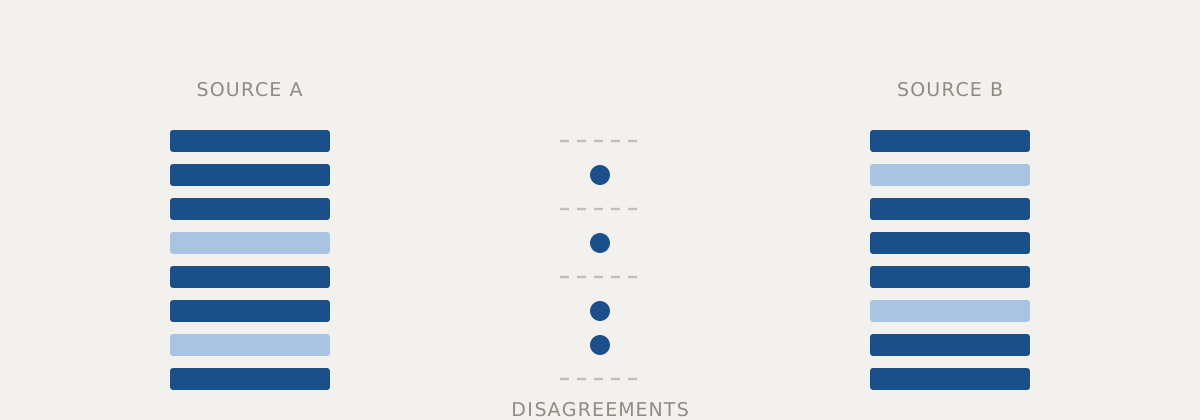
Asset inventory is the least interesting subject in security and the one that determines how well everything else works. It gets deferred because it produces no visible capability, has no compelling demo, and never appears in an incident report as the root cause — even when it was.
The reason it matters is structural. Nearly every other control is defined relative to a set of things, and if that set is wrong, the control is quietly wrong too.
What breaks, specifically
Coverage becomes unmeasurable. An endpoint agent deployed to ninety-eight percent of known hosts sounds excellent. If the denominator is a list assembled by a previous team from a spreadsheet, ninety-eight percent of it is not a statement about your estate. The hosts most likely to be missing from the list are the ones nobody is managing, which is the same population most likely to be unpatched.
Vulnerability management prioritises blind. Deciding what to fix first requires knowing what each system does and who can reach it. Without that, the only available ordering is severity score, which is precisely the ordering that sends people to patch lab machines while an exposed service waits.
Detections misfire in both directions. Rules that depend on knowing normal behaviour need to know what a machine is for. Absent that, a build server looks like a compromised workstation, and a compromised workstation running developer tooling looks like a build server.
Response slows at the worst moment. The first questions during an incident are what is this host, who owns it, what does it talk to, can we isolate it without breaking something. Answering those by asking around costs the hours that containment was supposed to save.
Why it decays
Inventories are not built wrong so much as built once.
The estate moves continuously — instances created and destroyed by automation, containers with lifetimes measured in minutes, contractor laptops, an acquisition arriving with its own domain and its own conventions, a team that adopted a SaaS platform without telling anyone because adopting it required only a credit card.
Any process that depends on humans registering assets will drift, because the people creating assets are optimising for something else and registration is overhead. The only inventories that stay accurate are the ones assembled from sources that update themselves.
Reconciliation beats enumeration
The productive technique is not to find one authoritative source. It is to collect several partial ones and compare them.
Cloud provider APIs know what exists in each account. Identity systems know what authenticates. Endpoint tooling knows where the agent is installed. Network telemetry knows what has an address and is actually talking. Configuration management knows what it manages. Each is incomplete, and none is wrong in the same way as the others.
The value is in the differences. A machine that appears in network telemetry but has no endpoint agent is unmanaged. A machine in the configuration system that has not been seen on the network for months is stale and possibly still holding credentials. An identity that authenticates from a host nobody has inventoried is worth a conversation.
Those disagreements are the actual output. A single reconciled list is a convenient artefact; the delta between sources is where the security value lives, and it is what a periodic job should be producing and routing to someone.
Ownership is the field that matters most
The technical attributes are easy to collect automatically. The one that is hardest and most valuable is who is responsible.
Without an owner, every finding becomes an unassigned ticket. Someone has to work out which team runs the thing, that person is usually in security, and the effort scales with the number of findings rather than the number of systems. With an owner attached at the inventory level, routing is automatic and the security team stops functioning as a dispatch desk.
Ownership also decays faster than any other attribute, because people change teams and teams get reorganised. It is worth deriving from something that updates on its own — the account structure, the deployment pipeline, the code repository that produces the artefact — rather than from a field someone typed once.
A reasonable target
Not perfection. A list that is assembled from self-updating sources, reconciled often enough that disagreements surface within days rather than quarters, and carrying an owner and a rough sensitivity for each entry.
That is sufficient to make coverage measurable, prioritisation defensible and response fast. It also happens to be the input that every tool you buy will ask for, and the reason so many of them underdeliver is that they were given a list nobody had checked.