Tools That Survive Contact With Your Environment
Procurement · July 31, 2026 · 9 min read
A security product demonstrates beautifully. The environment is clean, the data is representative, the scenario was chosen by people who know exactly what their tool is good at. Nothing in the demonstration is dishonest and almost none of it predicts what will happen in your estate.
The failure, when it comes, is rarely that the product cannot do the thing. It is that the thing requires an input you cannot supply, at a coverage level you cannot reach, maintained by people you do not have.
The prerequisite nobody lists
Most tooling assumes something about the environment and states it quietly, if at all.
Behavioural analytics assumes identity data clean enough to distinguish a person from a service account. Attack-path analysis assumes an accurate picture of what connects to what. Anything ranking risk assumes an asset inventory that knows what systems do. Anything correlating assumes timestamps that agree across sources.
When the assumption does not hold, the tool does not announce it. It produces output, and the output is subtly wrong in ways that take a quarter to notice. The question worth asking during evaluation is not “what can it detect” but “what does it need to be true, and is it true here”.
Coverage is the number that decides
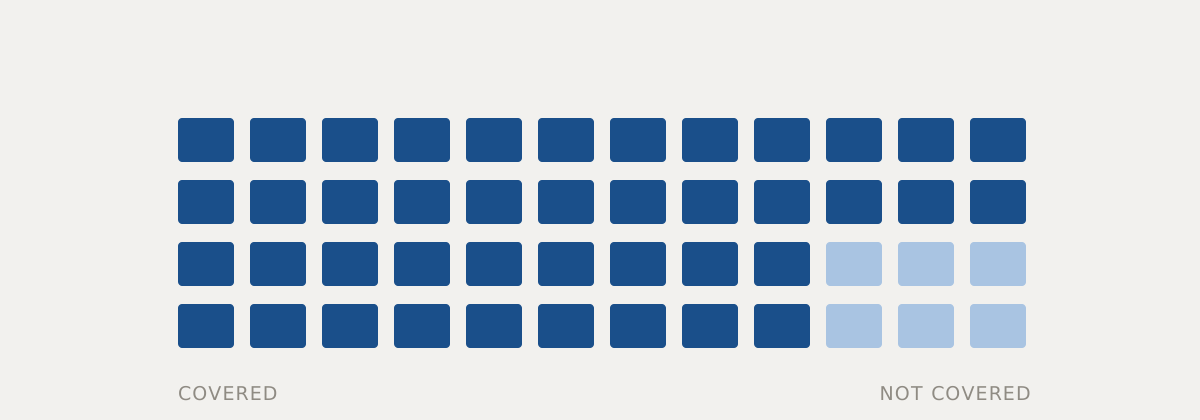
A control protecting sixty percent of the estate is not sixty percent as good as one protecting all of it. Attackers do not sample uniformly; they find the unprotected part, and the unprotected part is systematically the awkward one — the legacy platform, the acquisition, the appliance nobody can install an agent on, the environment owned by a team that says no.
Two questions predict a great deal:
What fraction of the estate can this actually cover, given the platforms we run? Not the vendor’s support matrix — yours, including the things you would rather not mention.
What happens on the part it cannot cover? Sometimes the honest answer is that the gap is acceptable. Sometimes it is that the gap is exactly where the risk concentrates.
Data out matters more than features
Every security tool eventually needs to talk to another one. The alert has to reach the queue; the enrichment has to reach the playbook; the findings have to reach the ticketing system where engineers actually work.
So the integration surface deserves more scrutiny than the feature list:
- Is there an API that exposes the same data the console shows, or a reduced version of it?
- Are the raw signals available, or only the vendor’s conclusions? Conclusions cannot be re-tuned when they are wrong.
- Can detection logic be exported, reviewed and version-controlled, or does it live only inside the product?
- What is the export path if you leave? A tool holding years of history in a format only it reads is a tool you will keep paying for after you stop using it.
Products that emit good data compose. Products that only emit conclusions become another console someone has to remember to check.
Operating cost is the hidden line item
Licence cost is visible and usually not the largest number.
The costs that surprise people are the ongoing ones: tuning during the first months, maintaining integrations that break when either side upgrades, responding to whatever new alert volume it produces, and the specialist knowledge that concentrates in one or two engineers who then become single points of failure.
A useful discipline before buying is to name the person who will own it, and to be specific about what they will stop doing to make room. A tool with no named owner reliably degrades into an unmaintained console that fires alerts nobody triages — which is worse than not having it, because it looks like coverage.
Evaluate on your own data
The most informative trial is one where the product runs against a slice of your real environment, including the ugly parts, for long enough to see a normal operating week.
What to watch: how much alert volume it generates before tuning and after, how much of that volume is actionable, how long integration actually took versus the estimate, and how it behaves when a data source misbehaves. That last one is revealing — every environment eventually sends malformed or missing data, and a tool’s response to that is a good proxy for how it was engineered.
Ask also what it does not see. A vendor who can describe their blind spots precisely has thought about them. One who claims there are none has either not looked or is not saying.
The uncomfortable summary
Most environments would get more benefit from raising coverage of the controls they already own than from adding another category. That is a harder programme to run and an easier one to justify: the estate is already paying for the tools, and the marginal gain from taking one from sixty percent coverage to ninety-five is usually larger than the gain from introducing a new capability at forty.
New tooling is worth buying when there is a genuine capability gap, a named owner, and honest answers about prerequisites. Otherwise it is a console, and consoles accumulate.